

Behind the scenes of preserving history: the digitizing process
MADISON – Last week’s column explored UAH’s archives as a community resource for preserving and researching local history. A big part of UAH’s archives being a community resource is the digitized artifacts they have made available online.
Though digitized artifacts are available at the public’s fingertips, an artifact does not become digitized overnight. Instead, the journey to digitizing artifacts is a multi-step process.
It starts with physically acquiring materials, which UAH does mainly through community donors, and after materials are acquired, they are processed.
“That’s the physical rehousing of things in acid free boxes and folders and also the creation of finding aids, like a box and folder list of the contents of the collection,” said archivist Drew Adan.
From there, materials enter the digitizing stage. They are scanned by a team of students using flat-bed scanners and a specialized Bookeye scanner. The Bookeye scanner is built specifically for larger items and with a cradle to hold books for scanning while limiting risk of damage to the spine and binding. UAH acquired the Bookeye scanner in 2020.
“This really kind of vastly increases the amount of material we can scan and the formats that we can scan. So, as you can see, we can do large format things like newspapers and posters and architectural drawings,” said Adan.
The scanner also increased the quality of images of artifacts by using two cameras and technology that removes glare from images, color corrects, and allows for full-text searching on scanned items.
In addition to scanning, students collect and enter the metadata associated with an item to fill out identifying aspects such as descriptions, dates, subjects, types, sources, and titles.
“More importantly than just scanning them is creating the metadata to go along with those images because you have to describe it in a way that’s findable and that researchers can find what they’re looking for,” said Adan.
Which collections and items are digitized are based on a number of factors like research interest, patron request, preservation concerns, or relevancy to major events, anniversaries, and holidays.
The archives team is currently planning the future digitization of correspondence, photographs, and architectural drawings from around 19501975 that tell the early history of UAH.
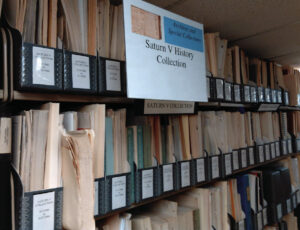
Currently, the Frances Cabaniss Roberts Collection is the only fully digitized collection, and parts of the Saturn V collection are also digitized. The digitization of the Frances Cabaniss Roberts Collection was led by a team of volunteers that included John Rankin between 2010 and 2020. Rankin and other volunteers used early wand scanners and digital cameras to photograph materials and used spreadsheets as indexes. They laid a foundation for digitization in the UAH archives that has been built upon since.
“UAH with [former archivist] Reagan Grimsley (now retired) and Drew Adan greatly improved the system for digitizing and making available many more archived data collections by providing much more modern equipments and students as staff to compile materials, organize the collections, and operate the equipment,” said Rankin.
Thanks to those early volunteers, the Frances Roberts Collection is readily available to the public online, and as more artifacts and collections are digitized by the UAH archives team, they will be accessible at libguides.uah.edu.